Invoice numbers look like a small detail until a GST notice asks why number 0047 is missing. The rules are short, but they matter.
The rules in one place
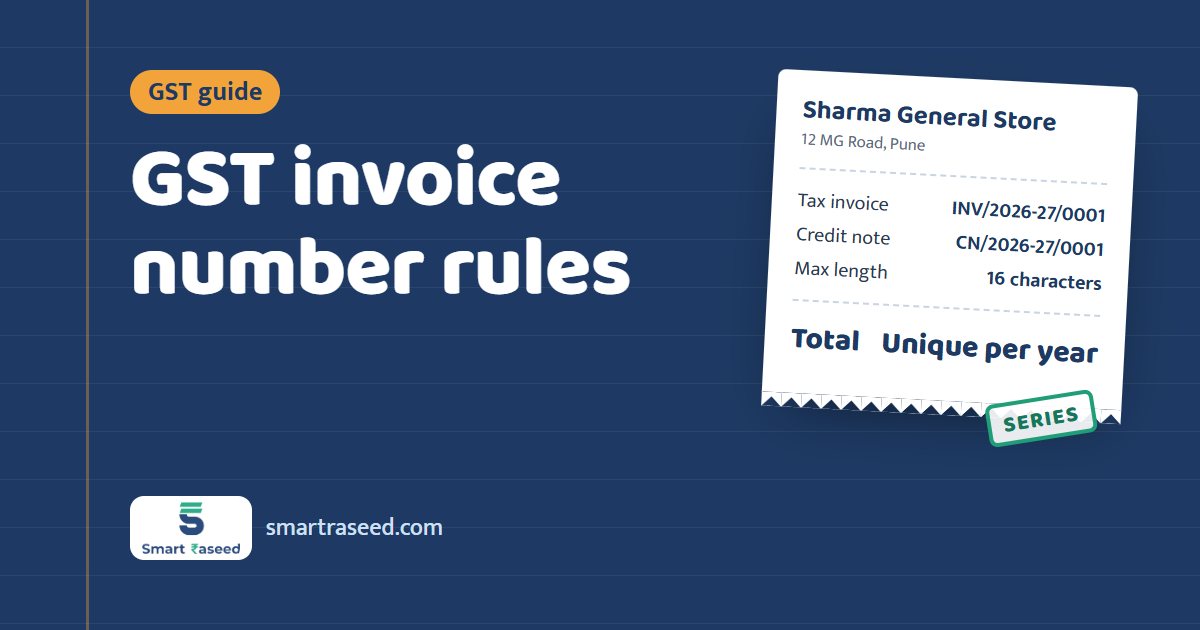
Under Rule 46(b) of the CGST Rules, a tax invoice number must be:
- consecutive, with no jumps or repeats in a series,
- unique for the financial year (1 April to 31 March),
- up to 16 characters long, and
- made of letters, numbers, hyphen (-) and slash (/) only.
Bills of supply (Rule 49), credit notes and debit notes (Rule 53) follow the same rules.
Good and bad examples
| Number | Valid? | Why |
|---|---|---|
INV/2026-27/0001 |
Yes | 16 characters, allowed symbols |
26-27/1042 |
Yes | Short and clear |
PUN/INV/26-27/0042 |
No | 18 characters, too long |
INV#0042 |
No | # isn't allowed |
0042 used again next month |
No | Repeats within the year |
Can you have more than one series?
Yes, and it's often clearer to. Common reasons:
- Document type:
INV/for tax invoices,BOS/for bills of supply,CN/for credit notes,DN/for debit notes. - Branches or counters:
PUN/andMUM/, each with its own running number. - Online and offline sales.
Each series must still be consecutive and unique within the year. You report every series you used in table 13 of GSTR-1, the documents issued summary, with the first and last numbers and how many were cancelled.
What about cancelled invoices?
Never delete a cancelled invoice or reuse its number. Mark it cancelled, keep it in your records, and count it in GSTR-1 table 13. A missing number with no explanation is what raises questions.
On 1 April: start again or continue?
Because numbers must be unique for the financial year, most businesses start a fresh series each year. Putting the year in the number makes this automatic and avoids clashes:
- 2026-27:
INV/2026-27/0001,INV/2026-27/0002... - 2027-28:
INV/2027-28/0001...
Continuing one long series across years is also allowed, as long as numbers never repeat.
Receipts for non-GST businesses
If you aren't registered under GST, no law sets your receipt numbering, but the same habits help. Use one running series per year, never reuse a number, and keep cancelled receipts.
How SmartRaseed numbers documents
SmartRaseed keeps a separate series for each kind of document and starts each one again every financial year:
- Receipts:
2026-27/0001 - Tax invoices:
INV/2026-27/0001 - Bills of supply:
BOS/2026-27/0001 - Credit notes:
CN/2026-27/0001 - Debit notes:
DN/2026-27/0001
All stay within 16 characters. Cancelled documents keep their number and are stamped CANCELLED, so your series never has unexplained gaps.