If you are registered under GST and sell to customers, the law fixes what your tax invoice must show. Get one field wrong and your business customer may not be able to claim input tax credit, which usually means an unhappy phone call and a corrected invoice.
The list of fields is in Rule 46 of the CGST Rules, 2017. This guide goes through it in plain language and ends with a filled example.
Who has to issue a tax invoice
A registered business that charges GST issues a tax invoice. Two groups issue a different document, a bill of supply, instead:
- businesses under the composition scheme, and
- businesses selling only exempt goods or services.
If that's you, read Bill of supply vs tax invoice instead.
The mandatory fields
About you, the seller
- Your name, address and GSTIN. Exactly as on your GST registration.
- Invoice number. A consecutive serial number of up to 16 characters, unique for the financial year. It may use letters, numbers, hyphens (-) and slashes (/). See GST invoice number rules.
- Date of issue.
About the customer
- Name, address and GSTIN of a registered customer.
- For an unregistered customer, name and address with the state name and code are needed when the taxable value is ₹50,000 or more. Below that, you can leave them out unless the customer asks.
About what you sold
- HSN code for goods or SAC for services. With an annual turnover up to ₹5 crore, 4-digit HSN is required on invoices to registered customers. Above ₹5 crore, 6 digits.
- Description of the goods or services.
- Quantity and unit for goods, such as 10 kg, 3 pcs or 2 box.
- Total value of the supply.
- Taxable value after any discount.
About the tax
- Rate of tax: CGST and SGST (or UTGST) for a sale within your state, or IGST for a sale to another state, plus cess if any.
- Amount of each tax.
- Place of supply with the state name, for sales to another state.
- Delivery address, if different from the place of supply.
- Whether tax is payable on reverse charge. Write "Reverse charge: No" on normal invoices.
- Signature or digital signature of you or your authorised person.
CGST and SGST, or IGST?
It depends on the place of supply, not on where the customer's office is listed:
| Your state | Place of supply | Tax on the invoice |
|---|---|---|
| Maharashtra | Maharashtra | CGST + SGST, each half the rate |
| Maharashtra | Karnataka | IGST at the full rate |
So an ₹1,000 item at 18% sold within your state shows CGST ₹90 + SGST ₹90. Sold to another state, it shows IGST ₹180. The GST calculator does this split for you.
A filled example
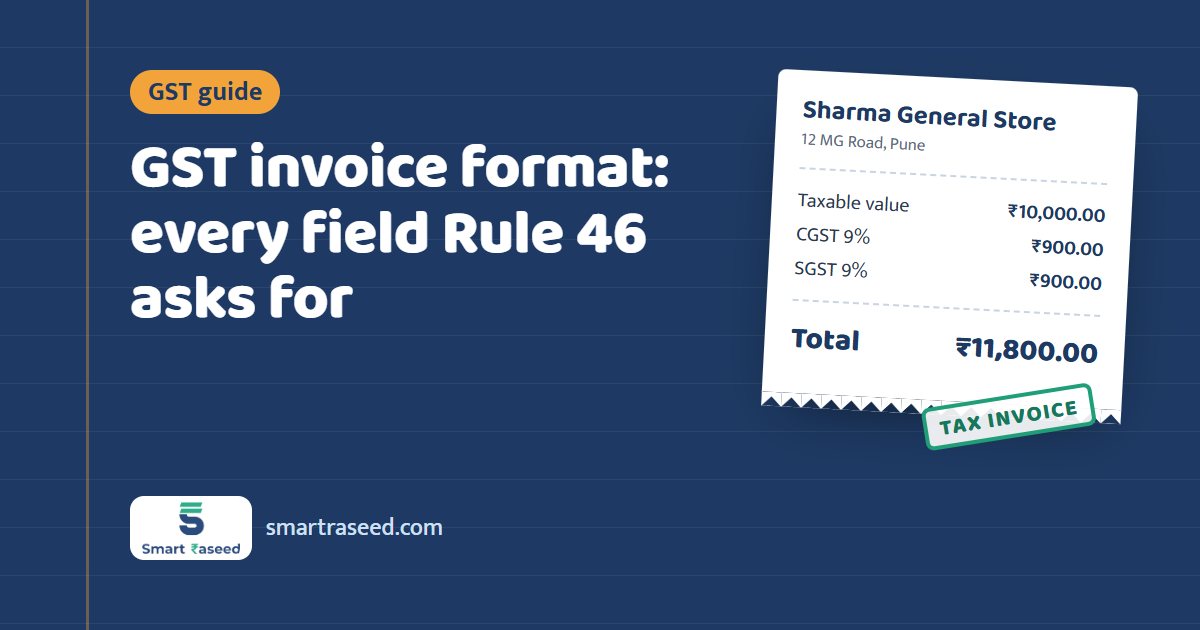
TAX INVOICE
Sharma General Store, 12 MG Road, Pune 411001, Maharashtra (27)
GSTIN: 27ABCDE1234F1Z5Invoice No: INV/2026-27/0042 · Date: 11 October 2026
Bill to: Verma Traders, GSTIN 27FGHIJ5678K1Z2
Place of supply: Maharashtra (27) · Reverse charge: No
Item HSN Qty Taxable value CGST 9% SGST 9% Office chairs 9401 4 pcs ₹10,000.00 ₹900.00 ₹900.00 Total: ₹11,800.00 (Rupees eleven thousand eight hundred only)
Authorised signatory
How many copies?
- Goods: three copies. The original goes to the buyer, the duplicate to the transporter, and you keep the triplicate.
- Services: two copies. The original goes to the customer and you keep the duplicate.
A PDF you send on WhatsApp or email works as the customer's copy. Keep your own copy safely: GST law asks you to keep records for about six years.
When to issue it
- Goods: before or at the time you hand over or dispatch them.
- Services: within 30 days of providing the service.
Common mistakes
- Missing or wrong customer GSTIN. The customer can't claim credit until you fix it.
- Gaps or repeats in invoice numbers. Never reuse a number, even for a cancelled invoice.
- Editing an invoice after sending it. Once issued, correct it with a credit or debit note, not by changing the original. See Credit note and debit note in GST.
- CGST and SGST on an inter-state sale. The place of supply decides.
Do you need e-invoicing?
If your aggregate annual turnover is more than ₹5 crore, invoices to registered businesses must also be reported on the Invoice Registration Portal to get an IRN and QR code. Smaller businesses don't need to.
Making GST invoices on your phone
SmartRaseed fills in your GSTIN and address automatically. It numbers invoices in their own series (INV/2026-27/0001), works out CGST and SGST or IGST from the place of supply, writes the amount in words and adds your signature. You share the PDF on WhatsApp in one tap. Once issued, an invoice is locked: you correct it with a credit or debit note, the way the law expects.