Walk into most neighbourhood shops and you'll still find a carbon bill book next to the counter. It works, it's cheap, and everyone knows how to use it. So why do so many shop owners switch to a digital bill book on their phone?
Paper vs digital at a glance
| Paper bill book | Digital bill book app | |
|---|---|---|
| Cost | ₹50 to ₹150 a book, again and again | Free or low cost |
| Speed at the counter | Writing by hand, carbon copies | Customer name and number fill in |
| Mistakes in totals | Possible, done by hand | Calculated automatically |
| Sending to customer | Hand over the slip | WhatsApp in one tap |
| Finding an old bill | Flip through books | Search by name, phone or number |
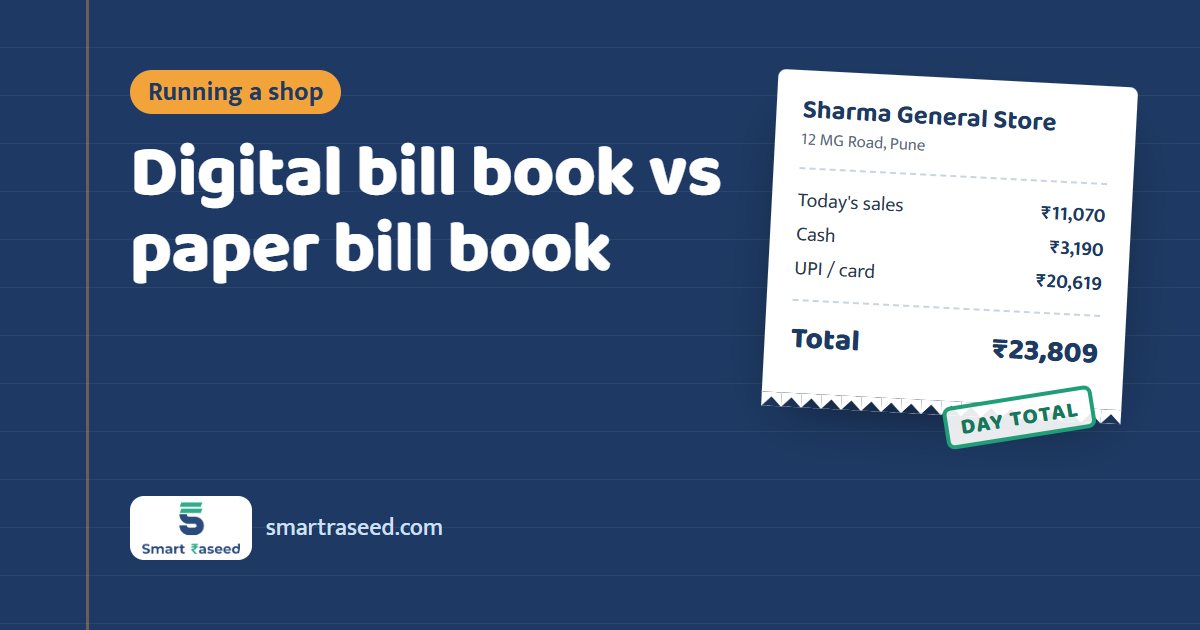
| Day and month totals | Add up yourself | Shown automatically |
| GST invoices | Easy to miss a field | Required fields built in |
| If lost or damaged | Records gone | Stored safely online |
Where paper bill books hurt
- Lost pages and faded carbon. The duplicate copy is your record. Once it fades, it's gone.
- Month-end totals. Adding up hundreds of slips for your accountant takes hours.
- Disputes. "I paid you last week" is hard to settle without a searchable record.
- GST mistakes. Handwritten GST invoices often miss a field like the place of supply, or get the CGST/SGST split wrong.
What a good billing app should do
- Make a bill in under 30 seconds.
- Remember regular customers.
- Support cash, UPI, card and online payments.
- Make GST tax invoices when needed, and bills of supply for composition dealers.
- Share PDFs on WhatsApp.
- Show today's sales and simple analytics.
- Work in Hindi as well as English, so everyone at the counter can use it.
- Export your records for your accountant.
A one-week plan to switch
- Day 1: Set up your business profile with your name, address, GSTIN if any, UPI ID, logo and signature.
- Days 2 and 3: Use the app for UPI customers only; they already have their phones out.
- Days 4 and 5: Use it for every bill above a fixed amount, say ₹500.
- Days 6 and 7: Use it for all bills. Keep the paper book as a backup for the first month.
- End of month: Export your bills for your accountant and compare it with your paper total.
Do you still need a bill for small sales?
For GST-registered businesses, sales under ₹200 to customers who don't ask for a bill can go on one consolidated invoice at the end of the day. Many shops still bill every sale because it keeps the day's total accurate.
Try SmartRaseed as your bill book
SmartRaseed is a free bill book app made for Indian shops, in Hindi and English. It makes receipts, GST invoices and bills of supply. It shows a UPI QR for the exact amount, sends bills on WhatsApp, and shows your day's sales and your best customers. See how it works.